How Website Speed, Design, and SEO Impact Your Sales
How Website Speed, Design, and SEO Impact Your Sales

Authored by
Admin
Date Released
January 12, 2026
Comments
0 Comments
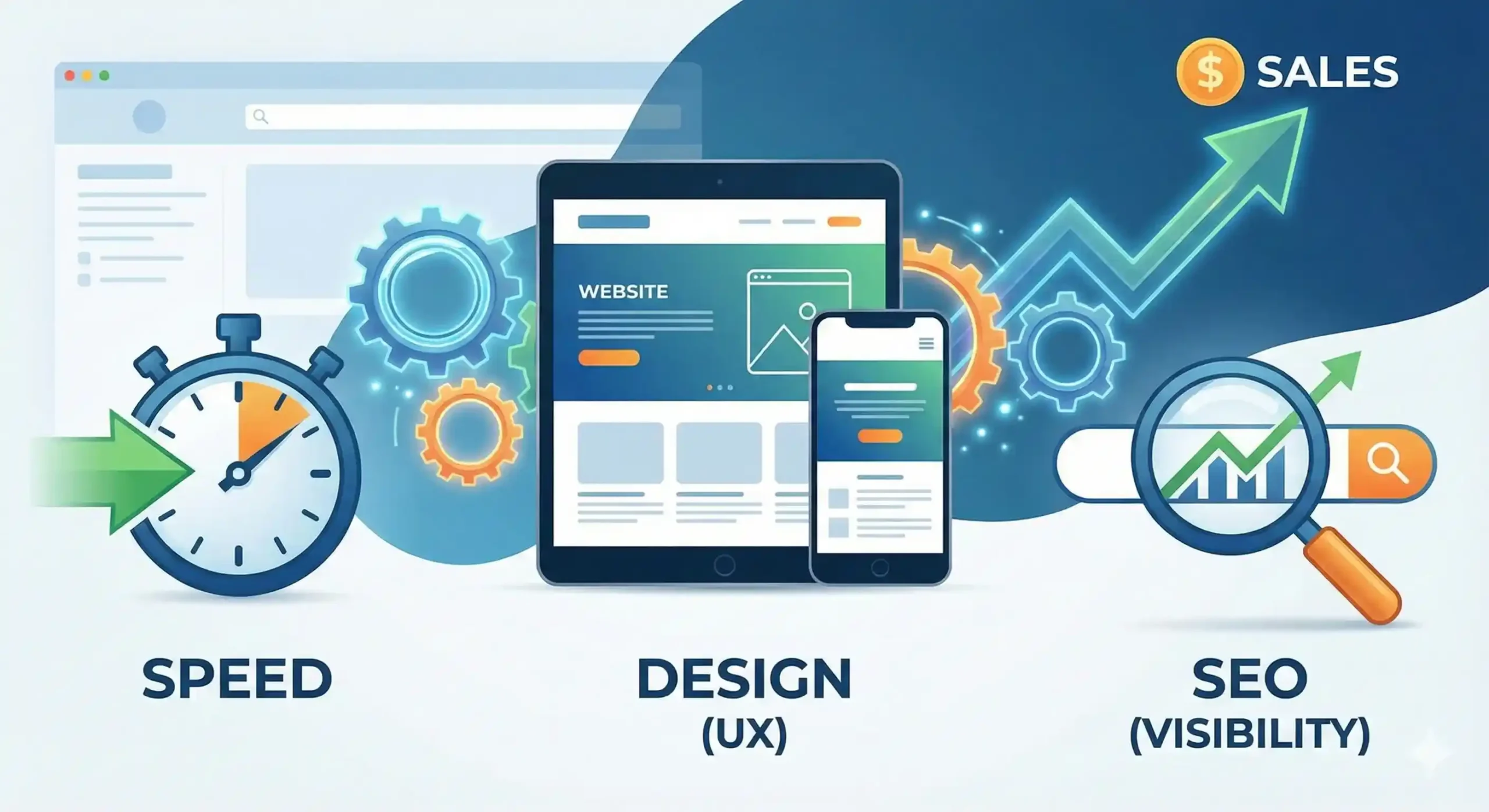
The impact of website speed, design, and SEO on sales is interconnected: SEO brings users to the door, design invites them in, and speed ensures they don’t leave before buying. A delay of just one second in page response can result in a 7% reduction in conversions, proving that technical performance is directly tied to revenue.
Key Takeaways
-
Speed Kills (Sales): A 1-second delay can cost you 7% of your revenue.
-
Design is Trust: Users judge your credibility in 0.05 seconds based on visual hierarchy.
-
SEO is Visibility: You can’t sell to people who can’t find you.
-
The IT For Future Solution: Custom-coded backends beat bloated templates every time.
Imagine walking into a physical retail store.
The door is heavy and takes five seconds to push open. Once inside, the lights are flickering, the aisles are messy, and the sales clerk is hiding in the back room.
Do you stay and buy? Or do you turn around and walk out?
This is exactly what happens online every day. You might have the best product in the market, but if your digital storefront is slow (the heavy door), ugly (flickering lights), or invisible (hiding clerk), you are leaving money on the table.
In our experience at IT For Future, we see clients obsessed with marketing spend while neglecting the very engine that processes those leads. Here is the deal on how Speed, Design, and SEO actually impact your bank account—and how to fix it.
1. The Need for Speed: Why Every Millisecond Costs You Money
Let’s look at the numbers, because they are brutal.
Google’s research shows that as page load time goes from 1 second to 3 seconds, the probability of a bounce (a user leaving immediately) increases by 32%.
If you are running an e-commerce site making $100,000 a day, a 1-second page delay could potentially cost you **$2.5 million in lost sales every year**.
Core Web Vitals Are Not Optional
Google now uses “Core Web Vitals” as a ranking factor. This measures:
-
Loading: How fast does the biggest image load? (LCP)
-
Interactivity: How fast can I click a button? (FID)
-
Visual Stability: Does the layout jump around while loading? (CLS)
If your site fails these, Google literally pushes you down the search results. You aren’t just annoying users; you are being penalized for it.
View Our Web Development Services
2. Design: The “Trust” Factor
You have about 50 milliseconds (0.05 seconds) for a user to form an opinion about your website.
That is faster than the blink of an eye.
If your design looks outdated, cluttered, or broken on mobile, users subconsciously label your business as “untrustworthy.” In the B2B world, where transaction values are high, trust is your most valuable currency.
Good Design Guides the Eye
Effective UI/UX isn’t just about pretty colors. It’s about Visual Hierarchy.
-
Does the user know where to look first?
-
Is the “Buy Now” or “Contact Us” button obvious?
-
Is the font readable on a $200 Android phone?
At IT For Future, we don’t just “paint” websites. We engineer user flows that psychologically nudge visitors toward conversion.
3. SEO: The Invisible Salesman
You can have the fastest, most beautiful website in the world, but it’s worthless if it sits in an empty desert.
SEO (Search Engine Optimization) is how you build the road to your store. But here is the critical part: SEO is not just keywords.
Google’s algorithms are now smart enough to detect “User Experience” signals. If users click your link, wait 5 seconds for it to load, and then click “Back,” Google learns that your site is a bad result. They will drop your ranking, and your organic traffic will dry up.
The “Revenue Trinity”
You cannot fix these in isolation.
-
Great SEO + Bad Design = High Traffic, High Bounce Rate (Wasted opportunity).
-
Great Design + Slow Speed = Frustrated users who leave before seeing your work.
-
Fast Speed + Bad SEO = A Ferrari in a garage that no one sees.
The Problem with “Generic” Solutions (and The IT For Future Fix)
Most businesses try to fix this by buying a $50 WordPress theme or installing ten different plugins to “speed up” their site.
This often makes it worse.
Pre-made templates are full of “bloat”—unnecessary code that tries to do everything for everyone. It slows down your site and hurts your SEO scores.
The Comparison: Generic Templates vs. IT For Future Custom Code
| Feature | Generic Template / Theme | IT For Future Custom Build |
| Code Structure | Heavy, bloated code (slows loading) | Clean, minimized code (lightning fast) |
| Scalability | Breaks when you add complex features | Built to grow with your business |
| SEO Foundation | Basic headers only | Schema, semantic HTML, & technical SEO built-in |
| Security | Vulnerable to common plugin hacks | Hardened security architecture |
| Conversion Focus | Generic layout | UX designed specifically for your customer |
Our Approach:
We build Custom WordPress Themes or React Applications from the ground up. We don’t rely on heavy page builders. We write clean HTML, CSS, and JS that Google’s bots love to crawl.
We recently helped a client migrate from a slow, template-based site to a custom solution. The result? Page load times dropped from 4.2s to 0.8s, and organic traffic increased by 150% in three months.
People Also Ask (FAQs)
Does changing my website design affect SEO?
Yes, absolutely. If you change your design without consulting an SEO expert, you risk breaking your URL structure, removing H1 tags, or creating heavy layouts that slow down the site. A redesign should always be a collaboration between designers and SEO developers.
How fast should my website load for good sales?
Ideally, your site should load in under 2.5 seconds. Anything longer than 3 seconds creates a noticeable drop in user retention. For e-commerce, aim for under 2 seconds.
Can I fix speed issues without rebuilding my site?
Sometimes. We can optimize images, implement caching, and minify code. However, if the underlying theme is poorly coded or the server is slow, a rebuild or migration might be more cost-effective in the long run.
Conclusion: Stop Leaking Revenue
Your website is an ecosystem. Speed, Design, and SEO are the climate, the soil, and the water. You need all three in balance to grow sales.
If you are tired of wondering why your traffic isn’t converting, it might be time to look under the hood. Don’t settle for a slow “template” solution that costs you customers.
Ready to build a high-performance sales engine?