Why Data Science Is Essential for Digital Business Growth
Why Data Science Is Essential for Digital Business Growth

Authored by
Admin
Date Released
January 13, 2026
Comments
0 Comments
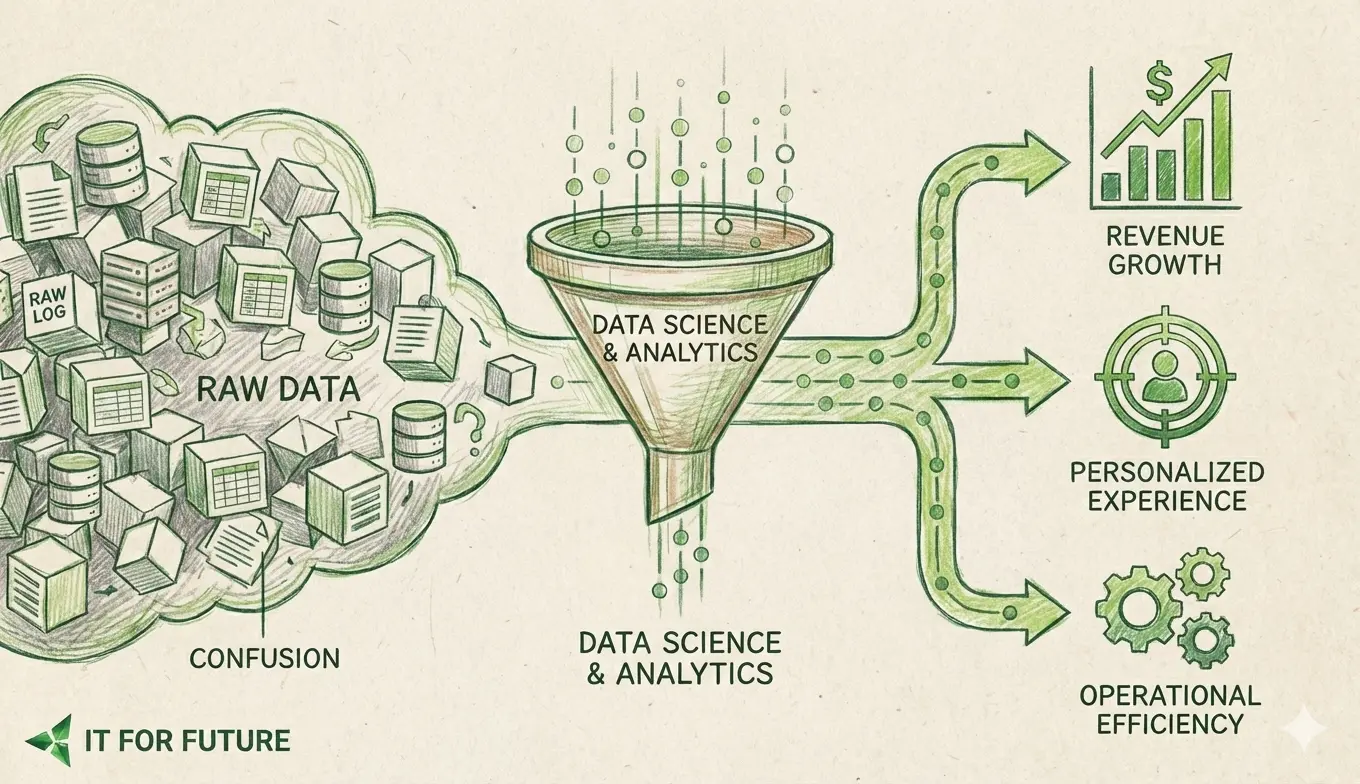
Data science is the process of extracting actionable insights from raw data to drive business growth. By using predictive analytics, machine learning, and statistical modeling, businesses can move from reactive decision-making to proactive strategies, directly increasing operational efficiency, customer retention, and revenue.
-
Predict, Don’t React: Shift from looking at what happened (reporting) to what will happen (predictive analytics).
-
Personalization at Scale: Use data to treat every customer like your only customer.
-
Operational Efficiency: Identify hidden bottlenecks that are costing you money every day.
-
The IT For Future Difference: We build custom data pipelines that fit your business, not generic dashboards.
You are likely sitting on a goldmine, and you don’t even know it.
Most businesses today are drowning in data. You have server logs, CRM records, website analytics, and sales spreadsheets. Yet, when it comes time to make a critical strategic decision, you rely on a “gut feeling” or a hunch.
This is the “Data Rich, Insight Poor” paradox.
In 2026, operating without data science isn’t just inefficient; it is dangerous. Your competitors aren’t guessing. They know exactly what your customers want before they do.
In our experience at IT For Future, we see that companies investing in data science grow 30% faster than those relying on traditional reporting. Here is why data science is no longer a luxury—it’s the engine of modern business.
1. Moving from Hindsight to Foresight
Traditional business reporting is like driving a car while looking only in the rear-view mirror. It tells you what happened last month.
Data science tells you what is about to happen.
Using Predictive Analytics, we can analyze historical patterns to forecast future trends.
-
Retail: Predict which products will sell out next month and stock up automatically.
-
Finance: Flag a potentially fraudulent transaction before it processes.
-
SaaS: Identify which customers are at risk of churning (canceling) so your team can call them before they leave.
2. Hyper-Personalization (The “Netflix Effect”)
Why does Netflix know exactly what movie you want to watch next? Data Science.
Customers today expect you to know them. If you send a generic email blast to your entire list, you are wasting money.
With data science, you can segment your audience based on behavior, not just demographics. You can see that “Customer A” buys only on weekends and prefers blue widgets.
-
The Result: You send them a targeted offer for a blue widget on a Saturday morning.
-
The Benefit: Conversion rates skyrocket because the offer is relevant.
Explore Our AI & Machine Learning Services
3. Operational Efficiency: Finding the “Hidden” Leaks
Profit isn’t just about making more money; it’s about wasting less of it.
We often work with logistics and manufacturing clients who think their operations are tight. But when we run their data through our models, we find inefficiencies they couldn’t see with the naked eye.
-
Supply Chain: Optimizing delivery routes to save 10% on fuel.
-
Staffing: Predicting peak support ticket times to schedule staff more effectively.
-
Inventory: Reducing “dead stock” that sits in the warehouse costing you storage fees.
The “Generic Tool” Trap vs. The IT For Future Way
Many businesses try to solve this by buying expensive “all-in-one” dashboard software. They plug it in, see a few pretty charts, and wonder why their revenue hasn’t changed.
The problem? Generic tools don’t understand your unique business logic.
At IT For Future, we don’t just give you a tool. We build Custom Data Pipelines. We connect your legacy SQL database, your modern cloud apps, and your Excel sheets into a unified brain.
Comparison: Off-the-Shelf Tools vs. IT For Future Custom Solutions
| Feature | Generic “All-in-One” Dashboard | IT For Future Custom Data Pipeline |
| Data Sources | Limited to standard integrations | Connects any data source (API, SQL, Legacy) |
| Flexibility | rigid templates you can’t change | Tailored exactly to your KPIs |
| Actionability | Shows you “what” happened | Tells you “why” and “what to do next” |
| Scalability | Gets expensive as you add users | Built to scale with your enterprise |
| Ownership | You rent their platform | You own your code and your data |
People Also Ask (FAQs)
Is data science only for big enterprises?
No. While big companies have more data, small businesses can often pivot faster. A small e-commerce store using data science to optimize ad spend can outmaneuver a larger competitor who is wasting budget on broad targeting.
What is the difference between Business Intelligence (BI) and Data Science?
Think of BI as “Descriptive”—it tells you what happened (e.g., “Sales were down 10%”). Data Science is “Predictive” and “Prescriptive”—it tells you why sales were down and what will likely happen next month.
Do I need to hire a full-time data scientist?
Not necessarily. Hiring a full-time expert is expensive. Partnering with a specialized agency like IT For Future allows you to access a team of senior data engineers and analysts for the cost of a single hire, scaling up or down as needed.
Conclusion: Stop Guessing, Start Knowing
The gap between the market leaders and the rest of the pack is widening. The leaders are using data to make precision strikes. The rest are guessing.
You have the data. You just need the right strategy to turn it into an asset.
Don’t let your most valuable resource gather digital dust.
Ready to turn your data into your competitive advantage?